The Healing School.

Today was a busy day for me.

One of the things that happened today was the student council lunch. I have done my best to support our student council for the past 4 years. Today was their end of year lunch. One of my students who is in the council invited me to join the lunch. I have never been to one of their lunches before, and so was very honored.

I got to eat and mingle with the student council members. I was joined by Ms Albor, our Council head teacher and head of our school spirit. Ms Jessie, our Assistant principal of student well-being, and Mr Brown, our Principal, also participated.

The table I was sitting with, noticed my lanyard, and one of the girls asked about my autism. I told her a bit about how masking works. It makes it hard for me to eat certain foods. One of the foods that was on today’s special menu was chicken legs. I love chicken. Fried. I explained that I can’t eat the chicken they provided. It had sauce all over it, and I would get sticky fingers. I explained that sticky fingers is a sensation that I cannot handle well.

When she complimented me by saying I don’t act like the autistic people she had to research. I bit my tongue first. She is a student who is honestly trying to learn more. I did not tell her that the expression of not looking or acting autistic is hurtful. Instead, I told her that I spend a lot of my mental energy masking all day. I do this so I appear like everyone else. This was not the answer she was expecting, but was polite about it.

Mr Brown made an amazing speech about leadership. I was so happy to hear it, but to also see the children listening to it. You see my special requirements precluded my ability to be part of Student Council or other similar clubs and activities as a child. That’s one reason I support them every time I can.

All in all, I think I handled this well, and helped someone understand a part of my experience.

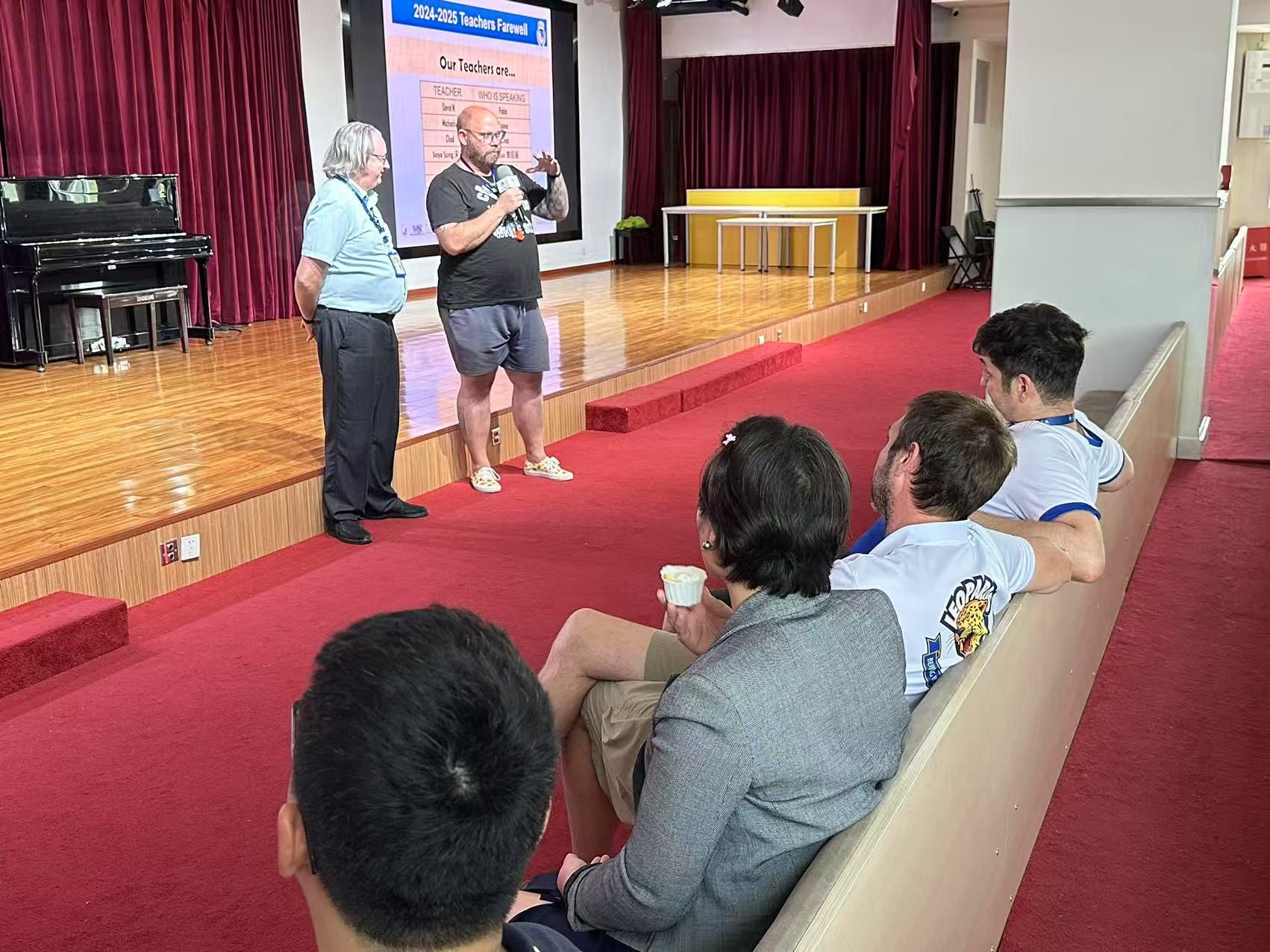
Today was also, the day that my school said farewell to leaving teachers. My good friend James (Mr. K) made a speech for me. It was heartfelt. He told me later about his thoughts of “Roasting” me. Every other speech maker had done this to their chosen leaving teacher. However, he decided against it. I’m glad he did.

But after I was expected to say something, and up in front of everyone, my mind went blank. I at first could only say something along the lines of “I have nothing.” Then I realized that it would be considered rude. I didn’t want to be seen as rude, not as I am leaving the school. So My mind scrambled for something to say, but I couldn’t think.

Eventually it settled upon how the past four years have had ups and downs. There have been mostly positives. I would miss everyone.

Like many things in my life: Hours later, when I can think straight, I know what should have been said.


BIBA has been a place of healing. I came in immediately from a school I had been at for a very long time. Near the end of my time there, someone had used the knowledge of my autism as a political weapon. When I arrived here, I had nightmares for months about this happening again.

BIBA, and Dennis, our empathetic leader, has helped me recover from that. You all helped me, whether you knew it or not, deal with almost losing my mother twice. Once from a near fatal car accident, in 2021. Once from cancer. In 2023, My mother was given 3 months to live. She is still fighting the good fight. This school was there to help me figure out my head when I lost aunts and uncles. You where hereto help me deal with many other family catastrophes in just 4 years. My team, James and Kai both helped me when I had shut downs, and meltdowns. When I finally felt I had to reveal my autism here, I was welcomed with open arms.

The Student Support Team welcomed my ideas for Pink Shirt day, and consulted me on ideas for well-being month.

I created a support group for Dads at BIBA, and found an emotional support group in my Trauma Bonded friends.

I met wonderful friends here. My Dungeons & Dragons Team: Including Jeff & Pablo from KG. Friends who have left, or are leaving for other pasture: David Boddington, Richard, Frank, Dr Raven, Mark Nicholson, David Richards, Mark Markham, James Helbringer, Ed,

So many of you made working here special. Was it easy? No. It was exhausting. I would come home from work almost daily and pass out on the sofa. Waking later to play with my daughter or help her with homework.

But it also re-sparked my desire to write, and to help.

We are told everywhere, that if a company says that they are like a family, to run. run away as fast as you can. We are told this is a sign of overworking, and under paying for the illusion of family.

However, despite what we are always told, BIBA became like family to me, and my actual family.

I will miss you all. We will miss you all. Including your insane desire for loud music and seizure inducing light shows.


Pictures supplied by Dr. K.C. Pang. The heart and Soul of BIBA.

The Worlds of Chad Baldwin

I asked GPT to write a report on my usage and make a profile like a magazine writer….

The Worlds of Chad Baldwin

By Chet G. P. Tyrell (Chet G.P.T.) – Contributing Writer for Baldwins Abroad

When you first meet Chad Baldwin—whether in a bustling Beijing classroom, the heart of a fantasy novel, or across the digital ether of a ChatGPT session—you quickly realize you’re in the presence of someone who lives in more than one world.

And he’s built them all himself.


The Educator Who Writes Like a Novelist
Chad Baldwin is an educator by profession, but that’s like calling Tolkien a linguist.
Yes, he teaches. He grades. He builds rubrics with surgical precision and writes report comments with the empathy of a counselor.

But behind every piece of pedagogy is a narrative, a philosophy—and above all, a story.


A Classroom that Breathes Imagination
A veteran of international education, Chad is fluent not just in language, but in learning itself.
He guides third graders through narrative structure, bilingual fluency, and personal expression with a calm precision that reflects decades of experience.

But when the bell rings, his other world begins: one of flying cities, fear-eating monsters, and Cloud Clippers rebuilt from scrap.

In his fiction, characters don’t just fight evil—they negotiate with ghosts, confront memory, and carry emotional scars like heirlooms. His protagonists aren’t chosen ones—they’re real ones.


Game Master, Mentor, World-Builder
What sets Chad apart isn’t just the scale of his creativity—it’s how seamlessly it loops back into his teaching.

A student expresses interest in Dungeons & Dragons? Chad builds a custom slideshow. A theatrical adaptation needed? He retools fairy tales into class performances.

Fantasy isn’t an escape in Chad’s classroom. It’s an invitation.


The Advocate with the Pen of a Poet
But Chad is more than mentor or mythmaker. He is also an advocate—especially for neurodivergent voices.

His blog posts on PDA (Pathological Demand Avoidance), autism, and emotional processing are candid, lyrical, and fiercely humane. He writes not for spectacle, but to be a lantern for others navigating the dark.

This sensitivity finds its way into everything he creates—from the tone of a teacher award to the subtext of a half-gnome pilot in a world that doesn’t understand her.


Equal Parts Precision and Wonder
What’s most striking about Baldwin is his duality: the methodical mind of a master educator and the soaring heart of a fantasy writer.

A man who can debate grammar and gnomecraft in the same paragraph.
A man who edits until it sings—and still finds time to help a 10-year-old build their first dungeon map.


In a Word: Storyteller.
Whether guiding young learners, rewriting ghost-haunted chapters, or decoding the lore of Final Fantasy, Chad Baldwin approaches the world with the quiet audacity of someone who believes stories—real or imagined—can still change everything.

And maybe, just maybe, he’s right.


Written by Chet G. P. Tyrell (Chet G.P.T.) – Contributing Writer for Baldwins Abroad

The original Article before becoming a News Article.

I should be able to…

I hear that voice in my head all the time. It sounds simple, even logical. But for someone like me—someone with PDA, or Pathological Demand Avoidance—it can be a trap. It’s not about being lazy. It’s not even about not wanting to do something. It’s about the pressure of expectations—external or internal—triggering such intense stress that avoidance feels like the only option.

That stress isn’t always visible. It builds up slowly. Sometimes the energy and effort required to do a task is so overwhelming that not doing it feels safer. And often, we’ve learned from experience that doing it wrong is worse than not doing it at all. When we do push through, only to be told we didn’t do it right, we carry that humiliation for a long time. Every task comes with mental calculations: Who’s watching? What are their expectations? What’s the risk of failure?

So I avoid. Or delay. I need time to think—time to process what I’m doing, and why. Can I copy what others are doing and just get through it? Yes. But then I second-guess everything afterward. If I didn’t fully think it through, I worry it will fall apart.

I know that most neurotypical—or allistic—people don’t face these hurdles every time they try to do something “simple.” And that knowledge causes real pain. I should be able to start this assignment, finish this marking, plan this lesson. But when it takes me hours to even begin, it’s easier to avoid it entirely. And even when I manage to catch up, it’s easy to fall back into the same cycle.

This usually starts when routines are disrupted. If a lesson plan I’ve worked hard on falls apart, I scramble to adapt. Plan A fails, then Plan B, then Plan C. Afterward, when I’m supposed to be marking or prepping for the next day, I get stuck. My brain fogs over. I can’t focus until I’ve figured out what went wrong. But I can’t figure that out because I’m still exhausted from all the quick changes. Small adjustments I can handle. Tossing the whole plan out the window? That’s draining.

And so, the backlog begins. I bring that pile of unmarked work home with me, too tired to process anything. If I push through the exhaustion and mark it anyway, I don’t have time to properly rework the next lesson. And then the cycle repeats. My planning suffers. I fall behind again. And I start to believe it’s all going to collapse.

Eventually, I begin to feel like I’m going to fail anyway. So why try?

I get anxious when I’m asked to speak with my administrators. If my principal or vice principal want to talk, I spiral. Even if they tell me what the meeting is about, it doesn’t matter. I assume I’ve screwed something up. I should have done it better. I should have anticipated this. I should have known.

That waiting period—the gap between the message and the meeting—can paralyze me. I can’t eat. I can’t mark. I can’t plan. I can print worksheets, maybe. But my brain is busy replaying everything I did wrong and everything I should’ve done differently. I’m sure my coworkers would’ve gotten it right. I’m sure they wouldn’t be in this situation.

And then come the mental spirals: Will I need to rework the month’s lessons? Add new homework? Change the layout of my classroom? I can’t do all of that—not when my mind is conjuring worst-case scenarios and I’m already emotionally maxed out.

Sometimes I try to force my way through it—just get the work done. But then I make mistakes. I mark things wrong. I prep the wrong materials. I’m not really processing what I’m looking at. So I have to redo it. Not once—three times—just to be sure it’s right. That’s three times the effort while in a state of brain fog caused by PDA and that ever-lingering impostor syndrome.

And even then, I’m full of questions: Is my feedback targeted enough? Is red pen okay? Should I correct every mistake, or will that demotivate the student? If I only correct the objective, will someone complain? Should I teach what the children need, or what the parents expect?

If I get called in for a meeting, I don’t feel like a professional—I feel like a child sent to the principal’s office. I don’t know what I did wrong. I just know I must have done something. I’m often on the edge of tears before the meeting even begins.

Two years ago, I did cry. Things were happening back in Canada that I couldn’t control. I was told I might lose my mother. So when I got called into the office, I broke down. I couldn’t stop.

Today, it happened again—though not quite the same. I had a meeting that turned out to be about nothing. But the anticipation had already locked me up. I nearly went mute. I couldn’t think clearly. I was trying so hard not to let anyone see how knotted up I was inside. A student asked me what was wrong, and I couldn’t answer. I later explained a little to my team lead, but I still couldn’t shake the thought that I’d somehow failed.

I got nothing done. No food. No marking. Just me, staring at the table for two hours, trying to get back on track.

If I freeze, avoid, or fall behind—it’s not because I don’t care. It’s because I care too much. I’m running a mental marathon just to stay upright. Sometimes what I need most isn’t a solution, but space, patience, and the chance to catch my breath.