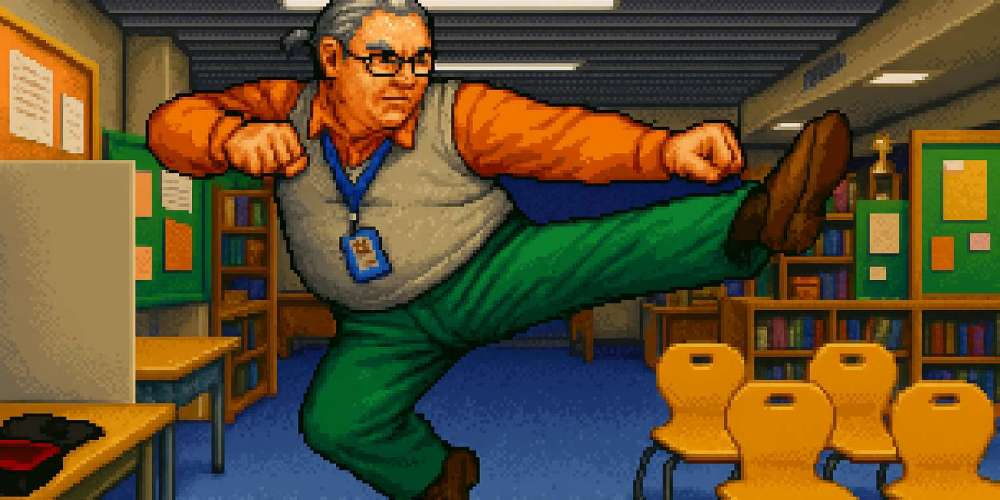
Button Mashing Through Life

Back when I was just a lad—you know the expression: knee-high to a grasshopper and all that—I used to play video games. (Not so much anymore.)

There was this one fighting game I played at home or at friends’ houses. It had almost no story. Just street brawls between characters from around the world. Nobody cared about the plot—except me. But that’s not really the point of today’s post.

You’d press buttons on the controller, and your character would attack, block, jump. If you pressed the buttons in just the right order, the character might throw a fireball or do a spin kick across the screen.

I could never pull that off.

More than once, I got accused of being a button masher—just frantically hitting buttons and hoping something cool would happen. I’d try to do a special move, and my guy would just… punch the air or crouch awkwardly.

So I fell back on the basics: jump, block, basic attack. Over and over. It was apparently the wrong way to play. “Cheap shots!” they’d say. “Come on, learn the moves!” But if I didn’t do it my way, I couldn’t play at all.

Then it got worse.

They released a Turbo Edition—it had more characters, sure, but the real feature? Speed. Everything moved faster. I barely kept up before, and now I was just mashing buttons in panic.

My friends got so good that they’d put the controller on the floor and play with their toes against me. One friend even disabled special moves entirely—and still had better reflexes.

It felt like the whole world had mastered this game. Meanwhile, I was barely hanging on, mashing buttons and hoping for a lucky win. It was frustrating. Honestly, I still can’t play real-time combat games. I just don’t think that fast.

But this isn’t just about video games.


Social Button Mashing

Growing up? Socializing? Going to school?

I was button mashing there, too.

Other kids seemed to know how to play the social game. They’d banter, joke, move from game to game, conversation to conversation, like they had the manual. I didn’t. I was just doing random things and hoping they were the right ones.

People made jokes, and I’d laugh—if others did. I usually didn’t get the punchline until an hour later. People told me things, and I believed them… until I found out later that I shouldn’t have.

My older brother used to ask me, “Do you want a USA?”

He never explained what that meant. The first few times, I said yes. I eventually learned that “USA” stood for Unexpected Sack Attack. A literal kick in the crotch.

It took me a few times to understand that it was always going to be a kick in the crotch.

So if I flinch when Americans say their country’s name, now you know why. And I apologize.

I spent years trying to play the game I thought everyone else was playing. I stuck to the same safe moves—repeat, duck, cover. But that’s exhausting. And lonely.


Turn-Based Thinking

That’s why I started playing role-playing games instead. In those games, nothing moved until I was ready. I could breathe. I could think. I could pause the world and plan my next step.

RPGs were like puzzle games where emotions and decisions mattered. I loved that.

And for a while, I believed that maybe I could learn how to be “normal” from these games—how people talked, how they handled problems, how they grew. They gave me space to try on different roles.

Looking back, I wasn’t just trying to win—I was trying to keep up. Trying not to fall behind in conversations, in friendships, in growing up. I wasn’t ‘playing wrong’—I just had a different controller, and that’s an important distinction.

Eventually, I realized something even better than games though.

Books were the real key.

Books didn’t judge how fast I turned the page. They didn’t expect instant reactions. They let me live someone else’s story for a while. And somewhere in all those pages, I started figuring out my own.

Rules are NOT Made to be Broken.

There is a common expression that irks me. “Rules are made to be broken.” I am sure you can guess why. I firmly believe it should be something like “Records are meant to be broken” (Please don’t break my LPs).

On Monday an amusing thing happened and I had to explain this concept to one of our Senior Staff. On Monday we had our Art Expo Gallery Event. The children have been preparing their art to put on display. On Monday afternoon, that had a lot of Art related activities including a Gallery Walk.

Before the Gallery Walk we introduced the Rules of a Gallery. Our Art teacher prepared a video and slide show for us to go over with our class. The Rules are simple, and for use in a real Museum or Art Gallery.

  • Do not touch the art.
  • Stay back behind the barriers
  • Let others around you see the art. (Don’t block the way)
  • Quiet.
  • No photos.
  • No eating near the art.

Shortly after this, one of my autistic students noticed our Head of School walking around near our classroom. They took out their Phone to take pictures of the Art. My student immediately went outside and quietly talked with the School head. I did not hear what he was saying, but then I was approached, respectfully, to ask about the rules. Apparently my student has asked him not to take pictures of the art.

I wanted to laugh, and it took me a moment to respond. I informed him that these were the rules set up by the Head Art Teacher. Then I asked him to follow the rules. He thanked me and left. When I was eating lunch, later, I finally got the words to explain, and sent him a message.

You see in most autistic heads, a rule is a rule. If there are exceptions, it is not a rule. We can and do learn about exceptions and the reason behind them, but when we are young it is hard. Autistic children will get stuck on analyzing what the exceptions are. They wonder if what they are going to do fits into those classifications. They will not ever be sure if what they are doing is alright, or not.

If they do it and nobody catches them, it reinforces their belief. They think this must be one of the exceptions. Then they are caught doing it wrong later. They get confused. They have to go back to trying to figure out what is ok and what is not.

In a school setting where rules may differ from home, this can cause a lot of confusion.

Children are not the only ones lost by this. Rules are created for a reason. In our minds, there must be a reason for these rules. Often they are safety, and following them will keep us from harm. Sometimes they are respectful, and disobeying will cause someone to be angry with us. No autistic person wants this, it does not “run off our backs like a duck.” Rules can be there to protect things, like our history, or other people’s property. We don’t want others breaking our things, and so empathize with them.

There are so many times, where my Mask and My need for following rules have clashed. Other Autists have this issue to. We often feel pressure to fit in and look like everyone else. This is how we keep our Mask up. But when everyone else is breaking a clearly stated Rule, it drives us nuts.

When I was studying to be a teacher, I had to deal with this. In the Men’s bathroom was this big no Smoking Sign. Daily, there was people standing next to it, or leaning against it smoking. I would ask them to go outside to smoke. The common argument was they didn’t want to go down to the first floor to smoke. Eventually, the building allowed smoking on the Fire Escape at the higher floors. We were on the 4th floor.

I handled this by going down to the 3rd floor. Alternatively, I would go up to the 5th floor to use the bathroom. This of course made people see me in a negative light. I was being a snob.

One of my early Schools actually had a fire. The auditorium caught fire. Did we follow the Fire escape plan we had practiced over and over again? Did we call the fire department? No. The fire had taken out the fire alarm for that building. Local Teachers were herding kids back into their buildings to not miss class. and the PE teachers began getting the fire hose out to put out an electrical fire.

I did my best to keep staff and teachers out of the building, and herd them to the safe zone. Two other foreigners did the same. I was so upset. Teachers and children could have died. The school was only worried about their test scores and reputation. They ordered us not to talk about it again.

I am glad I left that school.

Rules are here for a reason. And that reason isn’t so you can break them to look cool. They are not a challenge to accept. They are not there for fun.

Blankets

There is something amazing about a blanket. It is calming and comforting. Everyone should have a blanket.

I look back at Linus from the Peanuts comics. He was always seen with his blanket. My family used to call it a security blanket. He used to wear it as headgear or use it as a whip, but for me, that’s not realistic.

Ford Prefect from Hitchhiker’s Guide to the Galaxy always carried a towel.  In a way, it was his security blanket. But of all the uses mentioned, wrapping yourself up tightly wasn’t one of them.

I read and hear a lot about weighted blankets helping neurodivergent and autistics out. When I  was younger, I loved heavy blankets, and for years I never equated the two.

A heavy or weighted blanket puts a constant warm soft pressure on your body. That pressure helps you feel safe and calms you down when stressed.

For me, it is like a full body hug. A hug from someone who never judges you, never demands anything,  and never needs to break the hug until you are ready. I particularly enjoy snuggling in a blanket.

Unfortunately, when I got married, I didn’t have the words to explain my need for blankets.  I had always assumed everyone loved them like I do. My wife was raised without blankets. Where she was raised, in the tropics, blankets were more of a status symbol.

For the first few years of marriage,  my side of the bed had blankets at night. And even today on warm nights, she doesn’t use blankets. And heavy blankets are only for cold nights.

We have both adjusted to each other’s needs. Sometimes, with two different blankets on the bed.

But blankets are not just for beds. Our living room has a couple of thin blankets.  On stressful days, I will return home and cocoon myself on the sofa. Or half cocoon on medium stress days.

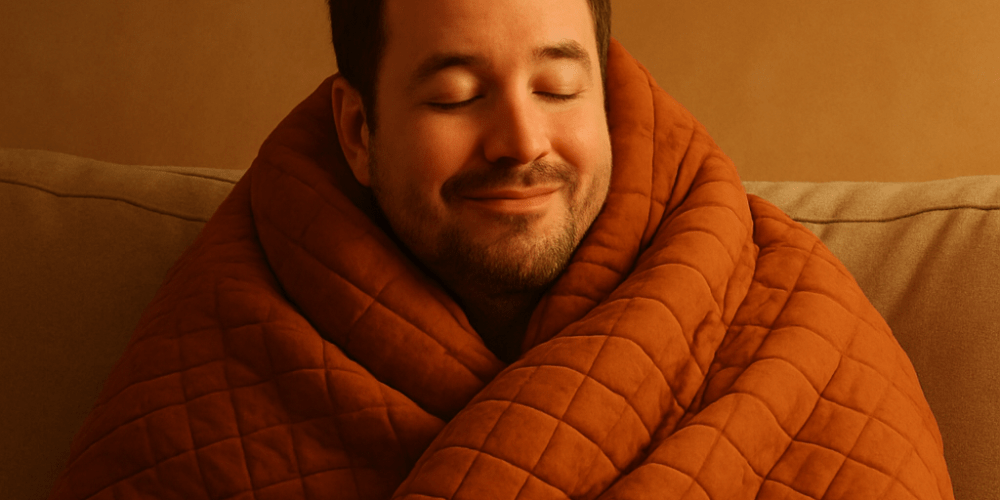
Cocooning is when you wrap the blanket tightly around yourself.  It gives the same comfort as a weighted blanket. I may lay down completely cocooned and isolated for a few hours.

On less stressful days, I will half cocoon. I wrap the blanket tightly around my legs and lower torso. Then I can drink tea or use the remote control to watch TV.

When in this mode, the TV is mostly for white noise. It doesn’t really matter what comes on. As long as it takes my mind off the day.

Tonight, I am up at a lodge for a church retreat with my family. My children and I are delighted that there are heavy blankets on all the beds. Just sitting here with it is relaxing.

Goodnight, I hope you all have amazing blankets