Family

Blankets

There is something amazing about a blanket. It is calming and comforting. Everyone should have a blanket.

I look back at Linus from the Peanuts comics. He was always seen with his blanket. My family used to call it a security blanket. He used to wear it as headgear or use it as a whip, but for me, that’s not realistic.

Ford Prefect from Hitchhiker’s Guide to the Galaxy always carried a towel.  In a way, it was his security blanket. But of all the uses mentioned, wrapping yourself up tightly wasn’t one of them.

I read and hear a lot about weighted blankets helping neurodivergent and autistics out. When I  was younger, I loved heavy blankets, and for years I never equated the two.

A heavy or weighted blanket puts a constant warm soft pressure on your body. That pressure helps you feel safe and calms you down when stressed.

For me, it is like a full body hug. A hug from someone who never judges you, never demands anything,  and never needs to break the hug until you are ready. I particularly enjoy snuggling in a blanket.

Unfortunately, when I got married, I didn’t have the words to explain my need for blankets.  I had always assumed everyone loved them like I do. My wife was raised without blankets. Where she was raised, in the tropics, blankets were more of a status symbol.

For the first few years of marriage,  my side of the bed had blankets at night. And even today on warm nights, she doesn’t use blankets. And heavy blankets are only for cold nights.

We have both adjusted to each other’s needs. Sometimes, with two different blankets on the bed.

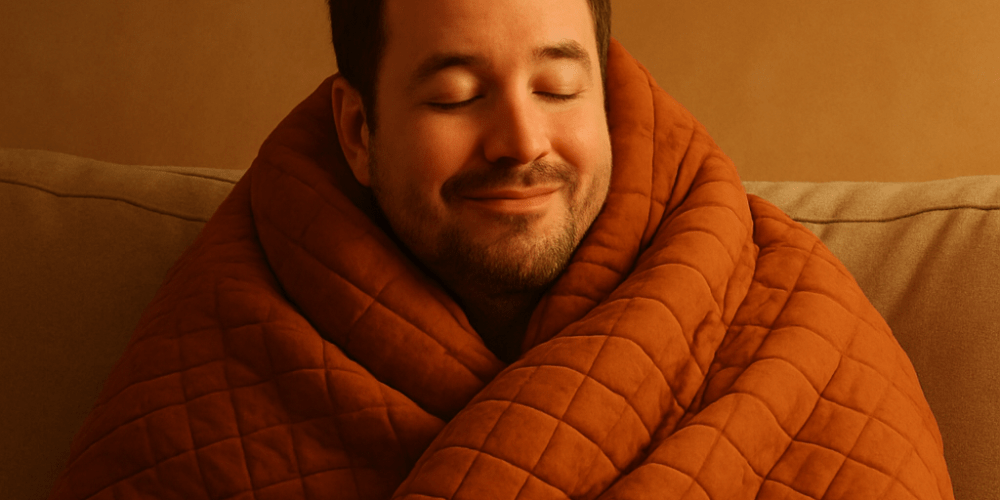
But blankets are not just for beds. Our living room has a couple of thin blankets.  On stressful days, I will return home and cocoon myself on the sofa. Or half cocoon on medium stress days.

Cocooning is when you wrap the blanket tightly around yourself.  It gives the same comfort as a weighted blanket. I may lay down completely cocooned and isolated for a few hours.

On less stressful days, I will half cocoon. I wrap the blanket tightly around my legs and lower torso. Then I can drink tea or use the remote control to watch TV.

When in this mode, the TV is mostly for white noise. It doesn’t really matter what comes on. As long as it takes my mind off the day.

Tonight, I am up at a lodge for a church retreat with my family. My children and I are delighted that there are heavy blankets on all the beds. Just sitting here with it is relaxing.

Goodnight, I hope you all have amazing blankets

I want to write…

I find writing very therapedic. I love writing, as most Autists do. But often times I just can’t do it. I will sit down with a great idea in front of my computer, and then something will interrupt me. Once I am interrupted, my brain doesn’t reset to work mode.

Tonight I opened my novel, Gateways, I was about to start writing ideas for chapter 5. As soon as the file loaded, my wife sat down beside me. She wanted to talk about our current Job hunt. I understand that, and I love my wife. So we talked about the future for a few minutes. maybe 5. and she left me to continue my writing.

It was gone. all my thoughts on the chapter had now been released to the wild. I sat there trying to focus, and I found I was no longer even in the mood to work on that book. So I opened up my New Valarians book. I started to make notes on Chapter 7 of that book, and it was not time to tuck my daughter in.

I love reading to my daughter, and tucking her in. It is one of my daily highlights. But when I sat back down, and stared at the book pages… nothing. Those thoughts had flown the coop. And I no longer felt the urge to work on that book.

So I sat staring at my screen, and drank my tea. and I thought I would share my notes on Autism and Writing.

Written Communication Over Verbal Communication.

Many Autists prefer to communicate through writing. There are a few reasons for this, but it starts with our difficulty with verbal communication.

When we speak to a person, there is an unwritten rule about the proper pace. How much time needs to be between each speaker. Too long, and the one speaker gets bored or thinks you are not listening. Too short, and you are too eager, or you are not listening, because you border on interrupting. Both are often labeled as rude. Also if an autist, like myself is talking and we get interrupted, we loose our thought process. We stumble, as we had our words laid out in our mind before speaking. When we write, we can take our time to plan out what we want to say. We can take our time, and not be interrupted.

Clarity is also an issue. When we want to communicate something, there is often a lot of details we want made clear. We want there to be no chance of misunderstanding, and so a lot of written messages are long. We cannot get that clarity when we speak. Allistic (neurotypical people) often ask questions to clarify. Once we have been asked a question, often times we have to spend time searching up the information in our brain to find the answer. Because of course the questions asked are not the questions we thought would be asked. Also the pause to find the best possible answer can be often seen as not knowing the answer. Thus it seems like we are deferring to the wisdom of the allistic person. Even if our information is more up to date, or correct.

I love writing. But I do not enjoy texting. I used to enjoy texting, back when it was simple. But nowadays, no. I will often times use voice to text, and then spend 15 minutes editing the text. You see when you communicate by text, there are now rules to texting.

You cannot make a large text, it is rude. You have to use simple words, because if you use real words it may offend the other person and be seen as patronizing them. CAPS CHANGE THE MESSAGE. So if you accidentally lock the caps on, you have to go back and rewrite it. Emojis are used to show feeling, and many other things. I liked it when there was just 5 emojis; 🙂 😀 😛 😦 @-}–

When I send text to people now I have to spend 5 minutes just scrolling through the emoji list. I’m asking myself which one is the correct one to use… I don’t know. If I put a flower, does it mean, I want you to have a happy day, or does it mean romantic feelings? Why do we even have an eggplant? and Flags? birthday cake? streamers? dogs? cats? soccer balls? Why can’t we just use words for these things?

When I am writing my novels, or my blogs, I do not need to use emojis. I can relish in the joy of real words. It is a blessing. It helps me de-clog my mind. However, sometimes, as is often the case in here, I feel it is unstructured.

It takes a lot of energy to structure my thoughts into comprehensible writings. Then to go back and add details can bean added hurdle. That’s kind of why lately I feel more like I am just rambling on my blog, but it brings peace to my mind and helps me sleep.

So that is where I am off to now.

Maybe this weekend I can get some writing on my books done.

Being Touched-Out.

I am touch sensitive. I enjoy soft, silky, and smooth surfaces. I love the feel of plush, or a good hug from someone I love. I love the feel of bark, and soft grass on my feet. On the other side, the idea of certain textures makes me shudder; wetness, slime, ooze, chitin, spiky, or shag. yuck. Even smooth bumps, like glossy stones pushed together give me the willies. The idea is bad, the sensation of touching them is worse.

There are these smooth bumpy stones you are supposed to walk over to relieve stress or massage your feet. They hurt massively. Like I mean I cannot walk on anything after I use those.

I am also extremely ticklish to the point of pain. I have never been to a masseuse, because the idea of a stranger touching me makes my skin crawl. I have this image of me laying on the table all ready to have my muscles soothed, and then they touch me with their cold hands and I involuntarily twitch off of the table. My best friend in High school used to call me “The Royal Tickle-Me-Elmo.” (If you don’t get the reference, please google it).

There is another side to this, that comes into play. Social. As a teacher in Asia, the children are always trying to hug you, and poke you, and push you. In Korea they have this “game” called a Dong-Shim. The children put their hands together with their pointer fingers pointed up, like a gun, and then try to shove that into the butt of the closest person. It’s horrid. In China, the younger kids often see you as a surrogate parent, and try to hug you. By the end of the day, you just don’t want to touch anyone or anything. You are touched out. I love hugs from my family, and people I trust, but others I have to mentally brace myself for.

When you are young, it doesn’t take very long to be touched out.

This week at church, there was a little boy, about 1 years old. Sweet guy. But he immediately latched onto my daughter. All he was doing was hugging her, and taking her finger to lead her around. He would gently push her to sit, so he could sit with her. But within 20 minutes, My daughter was touched out. She began trying to escape, and ended up having a short breakdown.

I took her outside the room to the water machine. She sat there and tried to just feel the space around her again. She was afraid of going back in with this little guy because he wouldn’t give her space. This is not the first time this has happened with her, so I knew what she needed. She used to have these troubles when playing with certain friends in Preschool. She didn’t want to be rude, either time, which made it worse.

The trouble is just that. When it comes to sensory sensitivities of any type, we don’t want to be rude. We are often afraid of offending, or scaring off potential friends. In the case of the little boy, she didn’t want to make him cry. But then, in order to be polite, or accommodating, we tend to let ourselves get pushed beyond our threshold. where the sensation is no longer an irritation, but becomes a source of panic.

People who don’t understand these sensations often misinterpret them as being rude, or mean. And this is where our fear comes from. “He’s just a baby.” or “They just wanted a hug.” looks innocent enough, but if you are at your threshold, one of 3 things will happen, and none of them are great:

  • Try to get away from the source of irritation. This can be trying to leave, but if the source follows you can lead to a panicked push away or a yell to get away. It is often the last choice before one of the other two happens.
  • Melt down. Collapse and cry. This often happens without choice, but is terrible because if you are melting down from too much touch, people want to console you by hugging you.
  • Shut down. again not a conscious choice. This involves your brain stopping, and you not reacting to the outside world. If continues for a while as you try to get your body to reactivate. Again, people may try to hold you to touch you to get your reaction. Which makes it last longer.

One of the worst things when working in a public space like a school is people don’t realize that crowds make things worse. If you have neurotypical children in a class, and autistic children in the same class, you have to spend a lot of time teaching both how to handle situations.

When an autistic child is having a meltdown or shutdown, it draws the attention of the whole class. Everyone is worried, and so everyone stands around them. Crowding them in, making the panic attack worse. I have to often herd the children away and ask for help from other teachers or admin to help move the children away. I have had days where I had to just lay down next to the child, and breathe slowly, so they can focus on the sound of my breathing.

On the flip side, I have been touched-out early in the day before. It happens from my sound sensitivity too. I’ve collapsed into a crying mess in front of the children. I am not a loud crier usually. I just flop-sit down, usually on the floor, and focus on my breathing as the tears flow. It does not happen often. But I have talked with my students about what they need to do if this happens.

I always pick a couple of students to lead. They make sure everyone is back at their desks giving me space. Then they try to get everyone quieter. I can usually function to a degree after a couple of minutes, but this took a long time to reach. There are still some days it takes me hours to be functional again.

My daughter has not learned these skills yet, and is not even comfortable setting her boundaries yet. I hope that I can help her learn to know when she is getting near her limit. I hope I can give her the confidence to say “No” when she needs space, or to just find a quiet space.

I don’t know how yet to teach her these, and am learning myself. My parents didn’t know how to help me with this, and my school councilors only focused on my speaking, reading and writing. So I am completely self taught.

The world is better equipped to help my daughter than they were to help me. Unfortunately, ignorance still pervades.

Until the world catches up, I will be wrapped up in my blankets. I will be teaching my children that its okay to do the same.