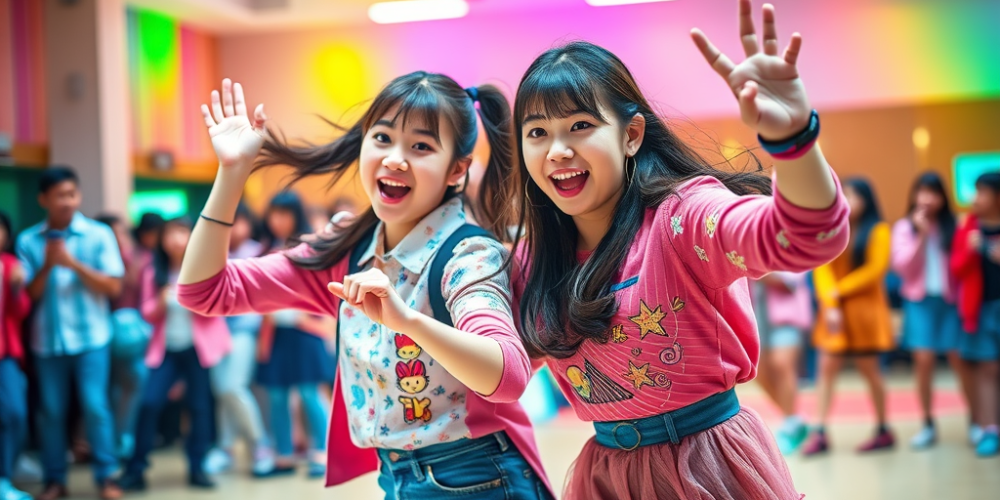
On our last day of school for the year we had an assembly, like we do every year. This year two grade five girls got a chance to show off their dance ability. It was marked on screen as Jazz Dance, but it was not jazz.
These two girls got up and did a dance very much inspired by K-Pop singers. My co-workers used the term twerking, but I don’t completely know what that means. There was discussion about how appropriate this was. And this brought back memories of conversations I have had in the past since moving to Asia.
My comment, which I voiced at the time: It’s their bodies & their fashion. He reluctantly agreed, but felt his voice should be heard.
Kindergarten Chaos.
Many years ago, I worked at a Kindergarten in Korea. for their year end event, the children performed a dance. It was a traditional dance. The boys were bare chested with sparkly vests and sparkly pants. The girls were wearing a skin-color shirt under a sparkly bra and sparkly shorts.
To my mind they looked like Las Vegas dancers in training. But I kept my mouth shut about it. Why? The parents had been involved with the costume selection, and dance routines. If the parents were happy to see their child in this outfit, in this context, then who was I to push my views on them.
Clothing.
Years later, a previous school I worked at held a charity bazaar. I love charity bazaars, or charity sales. The atmosphere is always very positive.
At this bazaar, a group of 4 of our middle school girls got up on stage and did a dance. It was a high energy, choreographed dance. (K-Pop inspired). A young teacher from California was sitting with me and he commented on the clothing the girls were wearing. Tight jeans, one I think had shorts, white t-shirts, and tank tops. He felt it was inappropriate for them to be dancing in such revealing clothes.
This year
I am not really a fan of K-Pop dancing. I have enjoyed some of the music, but don’t like the dance. Why? I get dizzy watching it. It takes a lot of training and energy to do, and I do not have the balance for this. When I see dancing, I imagine trying it in my head, and I feel like I will fall over. I don’t like this as it gives me a headache.
Not the reason most people expect.
I just cannot watch it. I do not judge the girls, or boys, who can dance this. I respect their ability and dedication. Is it twerking? I don’t know. I still don’t understand that term. Is it sexual? Some will think so. But I am then reminded of the movie Footloose (With Kevin Bacon). The town felt all dancing was sexual. I am not going to be the judge of what this generation feels is, or is not, sexual.
Any adult, who watches teenagers dance and feel strange things below, get help, please.
In my culture certain things are taboo. In Asian culture they are not. My wife enjoys watching this style of dancing. She used to dance it, as did her sisters, and her brother. My youngest daughter (Grade 1) will lock herself in her room to dance to videos. It’s great exercise.
Empowerment.
I was reading about, and watching videos about culture lately. One thing brought up was specifically, Japanese Girls fashion. And then I found similar notes about dance in Korea.
It is seen as a way to promote female empowerment. Girls here dress and dance in ways that would be considered extremely taboo in North America. They do these things to push against the old traditions of how Men got to dictate what they wore or how they moved. They do this to push against the quiet, modest stereotype of the older generations.
These girls, and women rightfully feel that they should be able to express themselves without people telling them what to wear or do. They are not hurting anyone. They are not asking for men to treat them or react to them in any special way. Quite the opposite, they are telling men to stop treating them or reacting to them in a certain way.
My final view, has gotten me in trouble in the past: If you cannot stop pushing your cultural values on the people here, maybe you shouldn’t be here.
North America is not the pinnacle of world culture. We love to think we are, but we are not. What is appropriate in Canada, or the USA, might not be alright here in Asia. And Vice Versa.
Where I do draw the line…
I do have a line though. It involves more comprehension, and it involves my autistic mind.
I love music. And when I listen to music, I cannot help but focus on the lyrics. I understand many people do not do this. I also understand that when people here listen to western songs, they often do not know what the lyrics mean. However, It irks me to see children singing or dancing along to songs about violence, sexual assault, cheating, or other immoral activities. I have been known to tell the adults in the child’s life what the song is about, r just to let the child know that the song has a bad meaning, without going into details. This extends to any media.
I have had enough children over my years in Asia try to copy the language used in an action movie or a rap song to practice from. these well meaning children use swear words and slang that they don’t understand, which makes me clinch.
I had a group of students 20 years ago who spoke mostly in quotes they heard from a counter-strike game. It was frustrating explaining to them that “Game over” did not mean they get to try again. Or that “taking someone out” was not an appropriate term to use while playing with someone in the playground.
Or a friend of mine who was trying to get over her boyfriend who cheated on her by listening to Shaggy’s “It Wasn’t Me” over and over again… That was an awkward conversation.
This is when I get irked. Not by fashion, or dance, neither of which I fully comprehend. And so I try my best to understand the music I listen to. I will often ask my friends and coworkers about the meaning of songs.

 Baldwins Abroad
You must be logged in to post a comment.