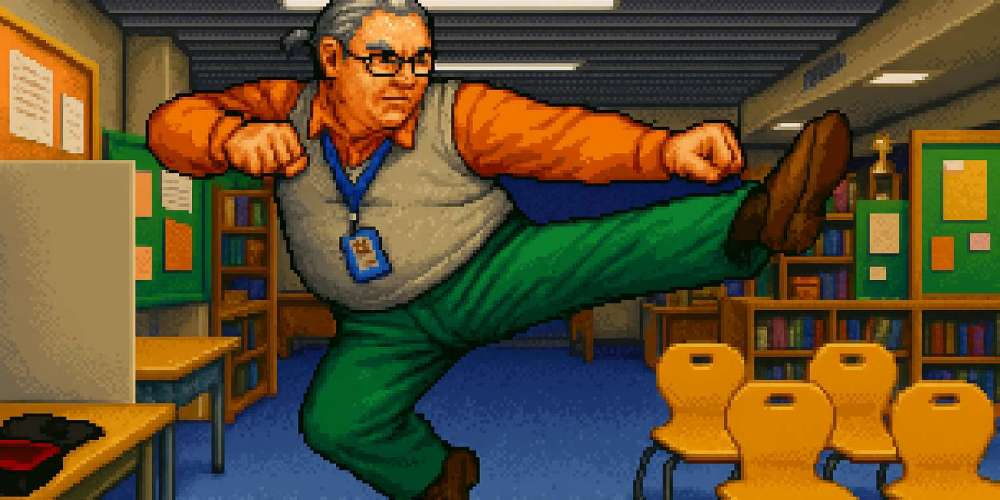
Back when I was just a lad—you know the expression: knee-high to a grasshopper and all that—I used to play video games. (Not so much anymore.)

There was this one fighting game I played at home or at friends’ houses. It had almost no story. Just street brawls between characters from around the world. Nobody cared about the plot—except me. But that’s not really the point of today’s post.
You’d press buttons on the controller, and your character would attack, block, jump. If you pressed the buttons in just the right order, the character might throw a fireball or do a spin kick across the screen.
I could never pull that off.
More than once, I got accused of being a button masher—just frantically hitting buttons and hoping something cool would happen. I’d try to do a special move, and my guy would just… punch the air or crouch awkwardly.
So I fell back on the basics: jump, block, basic attack. Over and over. It was apparently the wrong way to play. “Cheap shots!” they’d say. “Come on, learn the moves!” But if I didn’t do it my way, I couldn’t play at all.
Then it got worse.
They released a Turbo Edition—it had more characters, sure, but the real feature? Speed. Everything moved faster. I barely kept up before, and now I was just mashing buttons in panic.
My friends got so good that they’d put the controller on the floor and play with their toes against me. One friend even disabled special moves entirely—and still had better reflexes.
It felt like the whole world had mastered this game. Meanwhile, I was barely hanging on, mashing buttons and hoping for a lucky win. It was frustrating. Honestly, I still can’t play real-time combat games. I just don’t think that fast.
But this isn’t just about video games.
Social Button Mashing
Growing up? Socializing? Going to school?
I was button mashing there, too.
Other kids seemed to know how to play the social game. They’d banter, joke, move from game to game, conversation to conversation, like they had the manual. I didn’t. I was just doing random things and hoping they were the right ones.
People made jokes, and I’d laugh—if others did. I usually didn’t get the punchline until an hour later. People told me things, and I believed them… until I found out later that I shouldn’t have.
My older brother used to ask me, “Do you want a USA?”
He never explained what that meant. The first few times, I said yes. I eventually learned that “USA” stood for Unexpected Sack Attack. A literal kick in the crotch.
It took me a few times to understand that it was always going to be a kick in the crotch.
So if I flinch when Americans say their country’s name, now you know why. And I apologize.
I spent years trying to play the game I thought everyone else was playing. I stuck to the same safe moves—repeat, duck, cover. But that’s exhausting. And lonely.
Turn-Based Thinking

That’s why I started playing role-playing games instead. In those games, nothing moved until I was ready. I could breathe. I could think. I could pause the world and plan my next step.
RPGs were like puzzle games where emotions and decisions mattered. I loved that.
And for a while, I believed that maybe I could learn how to be “normal” from these games—how people talked, how they handled problems, how they grew. They gave me space to try on different roles.
Looking back, I wasn’t just trying to win—I was trying to keep up. Trying not to fall behind in conversations, in friendships, in growing up. I wasn’t ‘playing wrong’—I just had a different controller, and that’s an important distinction.
Eventually, I realized something even better than games though.
Books were the real key.
Books didn’t judge how fast I turned the page. They didn’t expect instant reactions. They let me live someone else’s story for a while. And somewhere in all those pages, I started figuring out my own.
 Baldwins Abroad
You must be logged in to post a comment.